The Blog That Speaks: When Competitiveness Loses
“Pay up!”
His voice announced an ultimatum with a demeanor to match it.

His face showed no sign of leniency or mercy. No evidence appeared that he was wavering in his demand.
Unfortunately for me, my pockets were empty. I was flat broke. I was not a prophet nor a fortune teller, but even I was able to glimpse into my future: I was teetering on the brink of bankruptcy. I was about to be forced to sell my assets in order to pay my creditor.
Fortunately for me, I was not embroiled with Ebenezer Scrooge. Scrooge would have gleefully sent me to a debtor’s prison or the union workhouse or wished for me to die in order to reduce the surplus population. No, a debtor’s prison did not await me. I was simply failing to win at a family game of Monopoly.

Photo by Stephen Harlan on Unsplash
I may have been naïve to believe that I had a chance to beat my father. He more than likely had obtained the nickname “Lucky” for a reason. He was highly competitive; therefore, I had very little hope to be declared the winner in Monopoly. The odds were in his favor, not mine. Just ask anyone who knew him.
His competitiveness was a personality trait that oozed everywhere. I recall as a child my dad insisting that our new house was to be built one to two feet longer than his hunting buddy’s newly built house. He wanted triumphantly to say, “My house is bigger than your house!”
If you were the unfortunate soul placed in the position to barter with my dad, it may have been easier for you to immediately submit to his demands than attempt to come out on top (or even hope for a draw). He drove a hard bargain and was the happiest if he believed he had gotten the better end of the deal.
In farming, his competitive nature surfaced not only by selling high and buying low but also in completing a job before anyone else. I remember hearing a story from his youth when he and a friend competed in the number of bundles of grain they tied during harvest. His friend foolishly threatened to put my dad “in the shade.” Needless to say, someone was “put in the shade” that day, but it was not my dad.
Reflecting on my dad has reminded me of a human tendency as my dad is not alone in his competitive spirit. The desire to compete, like my dad, seeps out of human beings in a multitude of ways. It may appear in more culturally acceptable avenues such as boxing, track, football, a job promotion, an election, or a game of Monopoly. Proving ourselves to be better than others may also emerge in less pleasing ways such as cheating in a business deal, bullying another child, verbally shaming others on social media, or seeking to eliminate the other. It can be evident in some surprising places, too. A person may be telling a story of hurt and pain when the would-be companion says, “If you think that is bad, wait until you hear what happened to me!”
Surprisingly, I hear competitiveness in grief support groups. Although the participants are encouraged not to compare their grief to another, inevitably from time to time, a participant says, “I think the worst type of loss is . . .” or “I am not as far on my grief journey as she is.” These comments are not simply noticing differences in grief journeys but turning grief into a competition.
What participants fail to understand is grief cannot be categorized from bad to worse, such as the death of a parent, sibling, spouse, or child. Instead, the worst type of grief is the one you are in right now. Such a perception invites empathy. It induces an embracing of our humanity, be it our own or someone else’s. It receives our vulnerability, which opens us to a place of connection—a place of energy where we know that we have been seen, heard, and valued. This is the place of healing.
Unfortunately, as humans, we frequently trade such healing opportunities for a chance to appear more powerful than we really are. And competition is a means to that end. It is an attempt for us to gain power over someone else and/or our situation. No matter if it is a game of Monopoly, football, a job promotion, cheating, or bullying, being better than someone else feeds our hunger for survival, the desire to be immortal. I feel powerful and unbeatable when I win, as if I will live forever. I may feel a little less corporeal if I am able to beat an opponent, to gain the upper hand. These are ways to see ourselves as more than a physical being who is destined to die and be forgotten.[1]
Perhaps I am overthinking it (not the first time), but I cannot help but ponder about a common scenario among friends or partners. Let us say you are having a conversation with a friend about something inconsequential—a jaunt down memory lane. The two of you are discussing a specific occasion from the past but remembering the sequence of events differently. You are firmly convinced that it transpired one way while your friend insists it happened another. Although it is a mild dispute concerning a trivial matter, something inside of you rises up. You are determined to hold your ground. Boiling forth from your being is an intense desire to be proven right. When it becomes evident that the two of you are at an impasse, a third friend happens along who also had been a part of the previous experience. Immediately, this friend is petitioned to recount the sequence of events of that bygone day. As the friend rehearses the progression of what had transpired, much to your delight, this person’s memory confirms your version of the story. In that moment, you feel smug. Triumphant. You won. The victory is yours. Feelings of power over your friend surface, despite it being a conquest of unimportance. In your estimation, you are better and more significant because you were right.
And for a moment, you can’t help but feel a little more . . . well . . . immortal.
This is the attraction of competition. Down deep within us, we are aware of our finitude, our human limitations. Hidden under multiple layers, we are mindful that we are mortal. However, through competition, I have a chance to obtain more power. To gain more control. To touch immortality. Competition presents us with the opportunity to defeat the other, and this allows us to believe that we are a little more godlike and little less mortal. For a moment, my feelings of helplessness are defeated, and for an instant, I may believe that that I can live forever. I am undefeatable.
Since we like this sense of being godlike, we look for ways to elevate ourselves. We may verbally (or physically) flagellate others, thereby deflating the other’s humanity while inflating our own. We puff ourselves up by demeaning the other, regarding ourselves as being more than human while negating the other’s humanity. This results in both parties not being seen, heard, and valued as human. Neither one is embraced for who they are. In such a place, both remain broken and in need of healing.
While the church is called to be such a healing place, many of us have experienced the opposite—a competitive spirit. Some have been on the receiving end of power-hungry church people. And, perhaps, we, too, have succumbed to these less-than-human tactics.
Scripture is not silent about the problems that competition creates. The first letter to the church in Corinth unveils how competitiveness had entered the hearts and lives of these believers. Possibly, this issue overflowed from their cultural frame of reference that embraced fierce competition. The ancient Greco-Roman athletic competitive games are renowned today, which also included the Isthmian Games near Corinth. These games, which were hosted by the “neighboring Isthmia,” included competition among athletes, musicians, dramatists, and rhetoricians and were “[s]econd only to the Olympiad.”[2]
No matter from whence it came, competitiveness loomed large in this house church. The Apostle Paul addresses multiple issues, and in the middle of them all, the spirit of competition is evident. Allow me to highlight a few of them:
- The Corinthians seemed to have an ancient rendition of children arguing, “My dad is better than your dad,” as they were divided over which teacher was the best (chs. 1–4).
- These believers disagreed concerning whether one may eat meat which had been offered to idols. A battle raged between the eaters and the abstainers, each desiring to be proclaimed the winner. The eaters fiercely believed that they had knowledge that gave them freedom to consume meat offered to idols, be it knowingly or unknowingly. The abstainers viewed eating such meat as idolatry (ch. 8).
- The Corinthian competitive nature emerged in relation to spiritual gifts. The more visible one’s spiritual gift, the more spiritual that person was (I must admit I have fallen into this thinking on more than one occasion). Speaking in tongues also became a means to appear more spiritual. This turned speaking in tongues into a path to accumulate more power or a higher position among the believers. Tongues became a status symbol, a vehicle used to boost themselves (chs 12 & 14).
But the one issue that I will explore here is the competitive spirit which surfaced in relation to eating the Lord’s Supper (ch. 11).
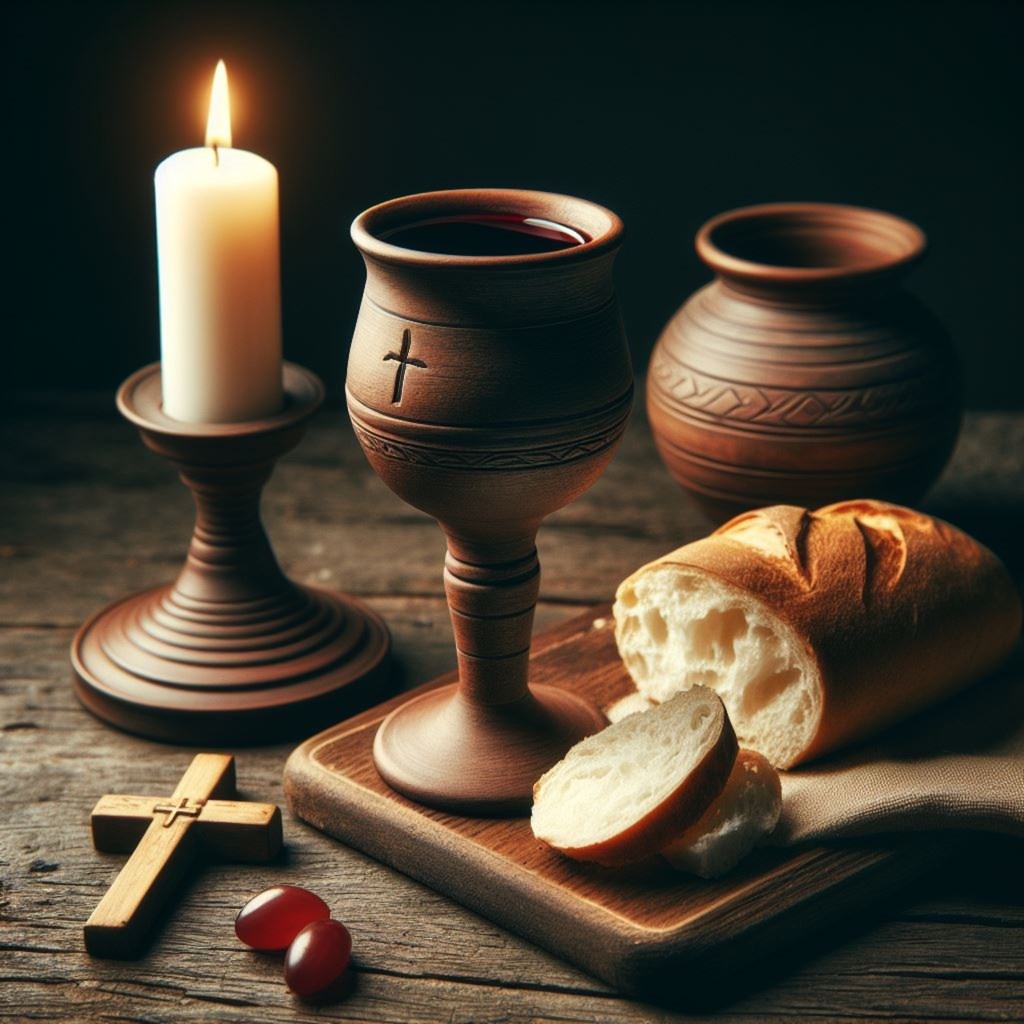
Partaking of the Lord’s Supper is not simply a repeated ritual, but it is also a way to tell a story—the story of the crucified Lord. As the bread is eaten and the cup is sipped, the story is told of Jesus, who refuses to cling to his divinity and ministers to humanity by entering into their death.
Image by Vesa Leppänen from Pixabay
The Corinthians, however, had transformed the retelling of the story of the Lord’s Supper into one of competition between the wealthy and the poor. The Corinthians were not partaking of the Lord’s Supper (v. 20) but eating of each one’s own supper (v. 21). Rather than retelling the story of the crucified Lord, they were embodying the telling of their own story. Their own story included social stratification where the rich exhibited power over the poor and behaved in a manner of superior importance. That is, a story of winners vs. losers.
In the Corinthian version of the story, the rich were shaming those who had nothing (v. 22) rather than participating in Jesus’s ministry by joining them in their nothingness. Instead of an opportunity for healing the sociological relational differences that were embedded in society, the upper-class were fashioning the Lord’s Supper into an occasion for division, for shaming. This was verboten! No class distinctions were to exist at the Lord’s Table. There was to be no clinging to status nor winners vs. the losers. Paul is clear: “For in one Spirit we were all baptized into one body.”
Paul knows that competitiveness fails to thrive when Christians “live out the story of Christ crucified in [one’s] community.”[3] Competitiveness seeks to be better, more powerful, and elevate itself. Competitiveness uses the other as measuring stick by seeking to be above the other to attract recognition. But this is not the story of God.
The story of Christ crucified is: God sets aside God’s status and quietly becomes one of us.
God lays aside being greater by joining us in our impossibilities, death, and hopelessness. The story of Christ crucified is God unpretentiously reaching us by participating in our death as the human-divine one. Through a death on a cross, God becomes the shame that humanity bears and thereby God overcomes it. By the way of the cross, God enters into the very depths of the blackness of human shame and hopelessness and conquers it.
This is the healing action of Jesus Christ, which is how he broadcasts to us, “I love you.”
In contrast to more than hundreds of social-media likes, the cross of Jesus Christ communicates boldly, “You matter.”
The cross is able to impart what winning cannot, which is “You are valued.” [4]
The cross does what competitiveness simply cannot do, which is heal.
While competition strives to avoid death, joining the other in death is that which heals and brings life. In the end, it is the cross, not competitiveness, that wins.
[1] Flight from Death: The Quest for Immortality, directed and edited by Patrick Shen (2003; Alexandria, VA: Filmakers Library), 36:50-37:39.
[2] Michael J. Gorman, Apostle of the Crucified Lord: A Theological Introduction to Paul and His Letter, 2nd ed. (Grand Rapids: Eerdmans, 2017), 278.
[3] Gorman, Apostle of the Crucified Lord, 282.
[4] Portions of this section on 1 Corinthians are taken from Pamela F. Engelbert, See My Body, See Me: A Pentecostal Perspective on Healing from Sexual Violence (Eugene: Pickwick Publications, 2024).